
Predicting Customer Churn Using Machine Learning in Telecommunications
Predicting Customer Churn: A Telecom Industry Case Study with Machine Learning
Discover how machine learning can predict telecom customer churn. Learn to clean data, handle imbalances, and deploy models (Logistic Regression, Random Forest, KNN) to retain high-risk customers. Perfect for data scientists and telecom professionals.
#CustomerChurn #TelecomAnalytics #MachineLearning #DataScience
Introduction: The Cost of Customer Churn
Customer churn is a critical challenge for telecom companies—losing a customer is 5-25x more expensive than retaining one. This project tackles churn prediction using machine learning (ML), analyzing a telecom dataset to
-
Identify at-risk customers (e.g., short-tenure, high-cost plans).
-
Optimize retention strategies with targeted interventions.
-
Reduce revenue loss through proactive measures.
Tools Used: Python, Scikit-learn, Pandas, SMOTE, and OpenML.
Key Insights from Exploratory Data Analysis (EDA)
Who is Most Likely to Churn?
-
Contract Type: Month-to-month customers churn 3x more than those on 1- or 2-year contracts.
-
Services: Customers without tech support or online security churn 2.5x more.
-
Billing: Electronic check users and paperless billing subscribers show higher attrition rates.
-
Demographics: Senior citizens and singles (no partner/dependents) are more prone to churn.
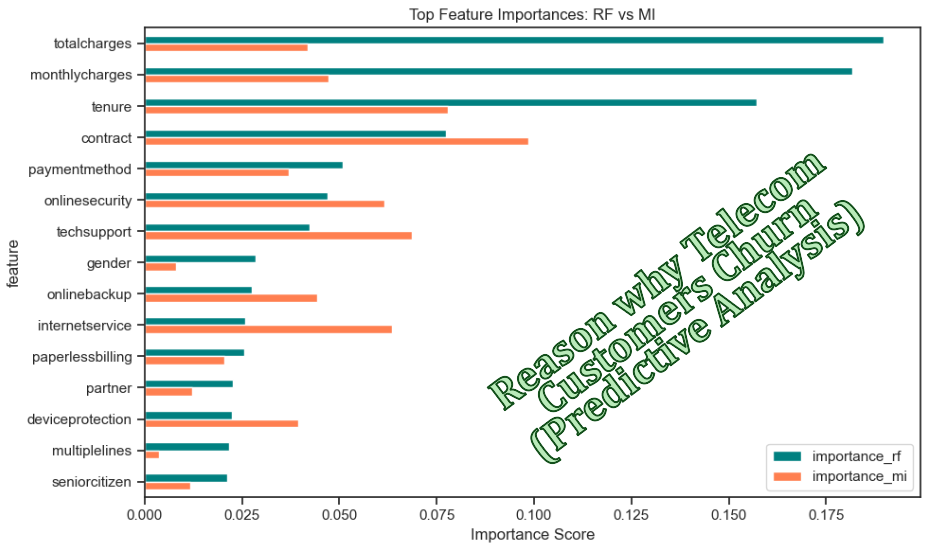
Top factors: Contract type, monthly charges, and tenure.
Data Cleaning & Preprocessing
-
Fixed missing values in TotalCharges (imputed with median).
-
Encoded categorical variables (e.g., Contract, PaymentMethod).
-
Addressed class imbalance (26% churners) using SMOTE.
Machine Learning Approach
Model Comparison: I trained and evaluated 4 algorithms:
| | | | | | --- | --- | --- | --- | | Model | Recall | F1-Score | Best For | | Logistic Regression | 0.83 | 0.79 | Interpretability | | Random Forest | 0.87 | 0.85 | Balanced performance | | SVM | 0.88 | 0.83 | High-dimensional data | | KNN (Selected) | 0.91 | 0.82 | Maximizing churn detection |
Why KNN? With 91% recall, it captures the most at-risk customers, Critical for retention campaigns.
Model Deployment
-
Proactive Alerts: Flag high-risk customers in CRM systems.
-
Personalized Offers: Discounts for month-to-month users.
-
Service Bundles: Promote tech support + security add-ons.
Actionable Recommendations
Target High-Risk Groups:
-
Offer loyalty discounts to month-to-month customers.
-
Upsell service bundles (e.g., internet + security).
Improve Customer Experience:
-
Proactively check in with short-tenure customers.
-
Simplify billing for electronic check users.
Monitor & Iterate:
-
Retrain models quarterly with new churn data.
-
Track intervention success rates.
Conclusion: Retention as a Growth Strategy : By leveraging ML, telecom companies can:
-
Reduce churn by 20-30% with targeted efforts.
-
Increase the lifetime value of retained customers.
-
Turn data insights into a competitive advantage.
Which churn factor surprised you? Comment below!